Monday, July 22, 2013

Digging My Grave

As I left off the account of my sojourn amongst the living and the dead of Spain last week, I was enjoying the beginning of a blissful Monday of rest after a week’s worth of toiling with pick and shovel under the unrelenting sun of the north central plains.  (By the way, I have, in fact, discovered that My Fair Lady is dead wrong.  The rain in Spain definitely does NOT fall mainly on the plain.  We have has scarcely a drop in two weeks here.  But I digress…).  After Monday’s rest, our hosts took us out again on Tuesday for an excursion.  The previous Tuesday was devoted to an excavation of a Roman villa, a trip to the Cantabrian coast for a dip in the Atlantic and, to round things off, a visit to Altamira and the Paleolithic cave paintings which rival the more famous cave art of the French cavern at Lascaux.  The next Tuesday trip was to the picturesque town of Segovia, perched in the central Sierra de Guadarrama just north of Madrid.  More on that and our other excursions later.  Today’s focus is properly on what I came here to do: dig the dead of Pintia’s La Ruedas necropolis.

This is a place that my new friend Carlos rightly calls magico, and that word has stuck with me as the most apt.  I already feel that a part of me will always remain here communing with these long gone Vacceans, these enigmatic Iron Age people of over two millennia past who built impressive walled cities, struggled against the irresistible encroachment of the Roman
The  view north from our dig site.  Each of the stelae in the foreground represents
a previously excavated tomb; a constant reminder of what we are about here.
This view is part of what makes Pintia so magical.
Empire, and left no written records of their own.  We have only fragmentary and tantalizing mentions here and there by Greek and Roman chroniclers who themselves were often relating second and third hand information and were biased besides.  There is one account of the siege of a Vaccean town by Hannibal, the Carthaginian general and scourge of the Roman Republic. With the town surrounded by Hannibal’s army with its war elephants and state-of-the-art military tactics, a warrior from the town emerged from the gates and rode back and forth in front of the enemy host shouting taunts and insults and demanding single combat.  A champion from the besieging army took up the challenge, and the two soldiers faced each other alone –  one clad no doubt in armor and wielding his sword, the other most likely nearly naked, brandishing his spear.  The Vaccean was slain and the town opened its gates and surrendered; but not before the fallen warrior’s son claimed his father’s body for the honor of a sky burial where his soul would be transported to the afterlife by the sacred vultures.

A collection of human bone fragments collected at the
necropolis.  Most of these have gone through the cremation
process.  The pale white bones were exposed to the elements
and the vultures in a 'sky' burial.  (For more items from the
dig, see my Pintia Artifacts album).
See what I mean?  These are the forgotten people I and my fellow volunteers are coaxing back out of the earth of north-central Spain, and they warrant remembering.  With every pot shard and fragment of wrought iron, with every piece of grey or black cremated bone or bleached white sky burial remains, I feel we are making that many infinitesimally small steps towards understanding these people on the western fringes of the Celtic world.  We may never truly understand them; these ancient dead will likely never relinquish their last secrets.  But we sweat and toil in the dirt to that end; in the process we are becoming a well-coordinated, cohesive team in which every individual discovery is, in fact, the group’s discovery and celebrated as such.  We are now down deep enough that we are beginning to uncover actual tombs with their grave goods and the excitement is palpable.  As it turns out, our site has proven to be a rich one.  We have already excavated two tombs, and are in the process of digging two more; we will likely not get to the three, perhaps four other tombs we strongly suspect slumber just under our feet.  Needless to say, we step very gingerly in the 4 x 8 meter hole we have created.

My corner before excavation.  The three limestone slabs were
thought to be capstones to a tomb.  (For more pictures of
Tomb 261, see my online slideshow)
My first real jolt of contact with the dead here came, as one might expect, from finding human remains.  We had been finding bones all along, but they had been animal bones, to the best of my knowledge, from graveside funeral feasts and offerings.  Then one day early in the dig, while screening the dirt for artifacts, I picked up a bone that looked decidedly different.  This bone fragment – the size of the end joint of my thumb, was a dark grey on the outside with black charring on the inner part, and was quite hard (mineralized).  The staff archaeologist I showed the piece to initially thought it was rock, then maybe animal bone.  However, I had a hunch that this bone had undergone intense heat for an extended time – not just a cooking fire.  So we showed it to Carlos I (the head of the Centro de Estudios Vacceas), who confirmed that it was human bone that had survived the cremation process.  As I turned this little fragment over in my hand it came to me.  This is part of a person.  That the person had died over 2,000 years before was immaterial to me at that moment.  This bone represented someone who had walked the ground I was standing on, had gazed northwards to the hills I looked at as I dug the dirt of the Duero Valley.  This was someone who had perhaps raised a family, had loved his wife, someone who had doted on her children and smiled as they played with the toys we had already begun finding.  I felt an onrush of complicated and contradictory emotions that all vied for my attention: exultation at the discovery and my ability to correctly interpret it, wonder at this intimate contact with the past, discomfort at holding what was left of a fellow human being.  In the end, I of course went right back to work, but not without a newly acquired and sober realization of just what we were doing here.  I sent a small prayer back through the ages to ask for understanding from those whose millennia of slumber we were disturbing. 

My tomb at end of day, with curve of the top
of a black clay jar visible.

Last Wednesday afternoon I was given a corner of one of the units to excavate where it was thought a tomb might be hiding.  Another possible tomb in the same was assigned to a couple of other volunteers, while the remainder worked on leveling and defining and exploring the other unit, from which the big stone stelae had been removed the previous day. 

The reason my corner was thought to contain a tomb was the presence of three flat, overlapping pieces of limestone; such an arrangement usually indicates that these are the capstones covering and protecting a grave, even though there was no stele over it (this was thought to have been shifted due to plowing).  So the first task was to excavate around the capstones and carefully remove them one at a time.  As soon as the first limestone slab came off and I began to clean the area, my trowel exposed the unmistakable curve of the lip of a black clay pottery bowl or jar.  We had to close up for the night at this point, leaving me with tantalizing visions of what lay beneath the other two capstones....  Meanwhile, 'my' grave, the first of the 2013 season, was officially designated Tomb 261.

Posing with artifacts in situ.
Thursday, needless to say, I eagerly got back to work on the remaining two slabs.  Once they were removed, I was free to gradually expose that jar by bringing down the level of the earth around it.  In doing so, I uncovered another bowl – this time of the polished black variety – and then a third.  Pretty soon I had exposed a small hoard of grave goods: four larger bowls and jars (three of the lovely polished black), a perfect little goblet, an unusual small decorated ‘bird’ bowl of uncertain use (perhaps an oil lamp), and a tiny clay box of the type thought to be used to store and serve salt.  The staff got pretty excited because several of the pieces were either unique or quite rare and different. 

Once exposed though quite careful, delicate trowel and brush work, then came the really nerve-wracking, painstaking process of removing the dirt around and under the pieces and one-by-one strategically remove them so as not to disturb the other artifacts.  Kind of like high stakes pick-up sticks and Jenga combined.  At times I was using my tiny dental picks and removing just a few grains of sandy soil at a time to get under the more delicate ceramics. 

Perfect goblet in foreground with red clay bowl and three bowls and jars of the
'polished black' variety that is my personal favorite type.  
So intent and absorbed was I in this meticulous work, that I entirely failed to note the arrival of the project documentary team until someone told me to look up.  Look up I did and found myself staring straight into the lens of a big video camera – just about jumped out of my Timberlands!  The videographers wandered about filming all the activity and coming back to my corner now and again.  Then came the extractions.  When a tomb’s artifacts are removed, the all other work on the site halts and everyone gathers around above, while other key people help out in the pit.  So I had an audience for my first removal of delicate, only partially intact 2,300 year old grave goods.  I was petrified; I think whole minutes went by without my taking a breath until I had finally cupped my hands under an artifact, ever so gently lifting it out of the soil which seemed reluctant to relinquish its treasure, and handed it up to competent, experienced hands above to be packed up safely. 
A view from the 'back' of tomb 261 showing black
clay jar (that did not make it out intact) small 'bird' bowl,
and in front left, the tiny clay box of the type used to
store and serve salt.

Wipe brow, breathe, repeat.  In the process I exposed yet another piece hiding underneath and had to carefully expose that.  Wipe brow, breathe, repeat – seven more times until all eight pieces were removed, all the while being videotaped and having various instructions called down in Spanish.  Amazingly, the pieces that were intact came out still in that state; the cracked and broken pots I managed to transfer to the storage trays (ordinary Styrofoam) in one lump with the contents still in place.

The small pieces.  Bull box, bird jar,
and surprise ladle(?) found
underneath the other two.
The moment that I will carry with me always was the little clay box.  It was in the ground at an angle, next to the little bird bowl, and when I pulled it out the people above sighed and ooohed and clapped; I turned it around and came face to face with the stylized head of a miniature bull on the front.  I stared at it and thought of the skillful hands who had crafted the tiny box and had put that simple, elegant bull head on it 2,300 years ago.  What had he been thinking?  Had he made it as a special gift for his child?  Was this toy-like artifact made specially for the funeral of a loved one, or was it something that had been used every day, touched by curious young hands, perhaps?  The quotidian meaning of this object remains enigmatic, but for me it was another magical jolt of electric contact with the past, a frisson of communion with a long-dead potter.  I described this to a Spanish archaeologist later who smiled knowingly and ran his hand over his arm and looked a question at me – yes, I replied, I had felt the goose bumps, and I feel them even as I write these words.

Fellow Volunteers Ben and Jen working on
Tomb 262, which yielded 9 major artifacts,
including an iron blade and a tiny goblet.
Thus my first successful tomb excavation.  The whole team was pretty pumped and all the
other volunteers eager to get at their own graves (odd phrasing, that) and see what they contained.  That evening we got the second tomb done as well – a much more complicated job with more artifacts in more precarious condition all jumbled together.  Again, all other work stopped and we held our collective breath as each delicate piece was extracted one by one.  Another success for the team to celebrate.  The pub at the little town of Padilla del Duero was hopping that night!


Next day it was back to cleaning, leveling, exposing, defining, screening, mapping and drawing the site as we took it further and further down in search of the Dead of Las Ruedas necropolis.  More on that later….


Monday, July 15, 2013

Digging the Dead

Map showing location of Vaccean territory with Pintia highlighted.
Madrid is due south of Pintia. (Map courtesy of Carlos Sanz and
the Centro de Estudios Vacceos 'Federico Wattenberg').
As my Fearless Readers will know, I am in Spain on a trip of which the main event is a month-long archaeological dig in an ancient Celtic cemetery, or necropolis as they say in the business.  After a couple of days in the capital, I met the dig organizers and other volunteers (eight of us in total) at the airport, and we piled into a van and a car and off we drove north in the direction of Burgos.  After about an hour and a half of traveling in some of the most beautiful and rugged countryside I have seen, through the Sierra de Guadarrama and onto the broad plateau lands of the Meseta Central, we reached the Duero River and turned west towards Valladolid.  After passing through a town called Peñafiel, which you can spot from a couple of miles away due to its brooding
The Peñafiel castle looming over the Plaza de Coso where they hold
bullfights.
castle perched on a high tor above the town, we arrived at the little town of Padilla de Duero, official population 68 souls on a good day (see below).
  This is where the center for the dig is located, and where we call home; the actual dig site is a mere quarter mile or so from town. 

The area of Spain we are in is part of the dual province (or Communidad Aútonomo – roughly the equivalent of a U.S. state[1]) of Castile-Léon.  This is the breadbasket of Spain, while much of the rest of the country is either too mountainous or not fertile enough for large-scale agriculture.  The Duero River Valley, locals will tell you, is the most fertile of all the lands of Spain – here is where much of the nation’s grain is produced, as well as fruits, vegetables and, most important of all to hear the locals talk, wine.  (On which topic more later…).

This region was just as fertile and varied millennia ago as it is today, and therefore was magnet for human settlement from the dawn of modern man.  2,500 years ago, a large part of the Duero Valley was home to a group of Celtic-speaking people called the Vacceans (or Vacceae).  The rest of Spain was inhabited by various other Celtic and ‘Iberian’ peoples.  The Vacceans controlled a vast territory and developed quite large city-states, of which the Celtic (and subsequently Roman) town of Pintia was prominent.  The site we call Pintia
The fertileDuero River valley from the castle of Peñafiel.  The landscape is
dottedwith fields of wheat, potatoes and, most especially, vineyards.
today had a population of as many as 5,000 or more, at any given time, pretty much continuously for some six centuries.  The oppida (a Roman word for a fortified settlement, typically situated on a hilltop) itself was protected by an impressive wall and ditch system and has been extensively excavated since the 1870s.  Called Las Quintanas, it had an adjacent artisanal quarter where the production of ceramics reached industrial proportions, as well as an extensive necropolis, which was discovered in the late 1970s.  The current focus of excavation is that cemetery, with the intention of getting a better grasp on the day-to-day lives of the Vacceans through the ‘archaeology of death.’  Thus far 260 tombs have been discovered and excavated, most since the outset of the current century.  This may seem like a lot of tombs until one starts to do the math.  Conservatively, if one takes 5,000 as the average population over the course of some 20 generations, simple math hints at tens of thousands of tombs in this place over the six centuries of occupation. 

The majority of the burials in the vast necropolis of Las Ruedas, as it is known, are cremation interments  in which the ash and bone products of a massive funeral pyre were placed in urns and buried in pits along with various personal items as well as ritual offerings (in the biz these ‘grave goods’ are known as the funeral trousseau).  Some of the warrior-aristocratic elite were ‘exposed’, rather than cremated; they were left in the open for the vultures to devour and then the bones were collected and buried as customary.  This may sound gruesome and even insulting to modern sensibilities, but these ‘sky burials’ were a great honor, since the vulture was regarded as a sacred bird which transported one’s soul directly to the afterlife.[2]

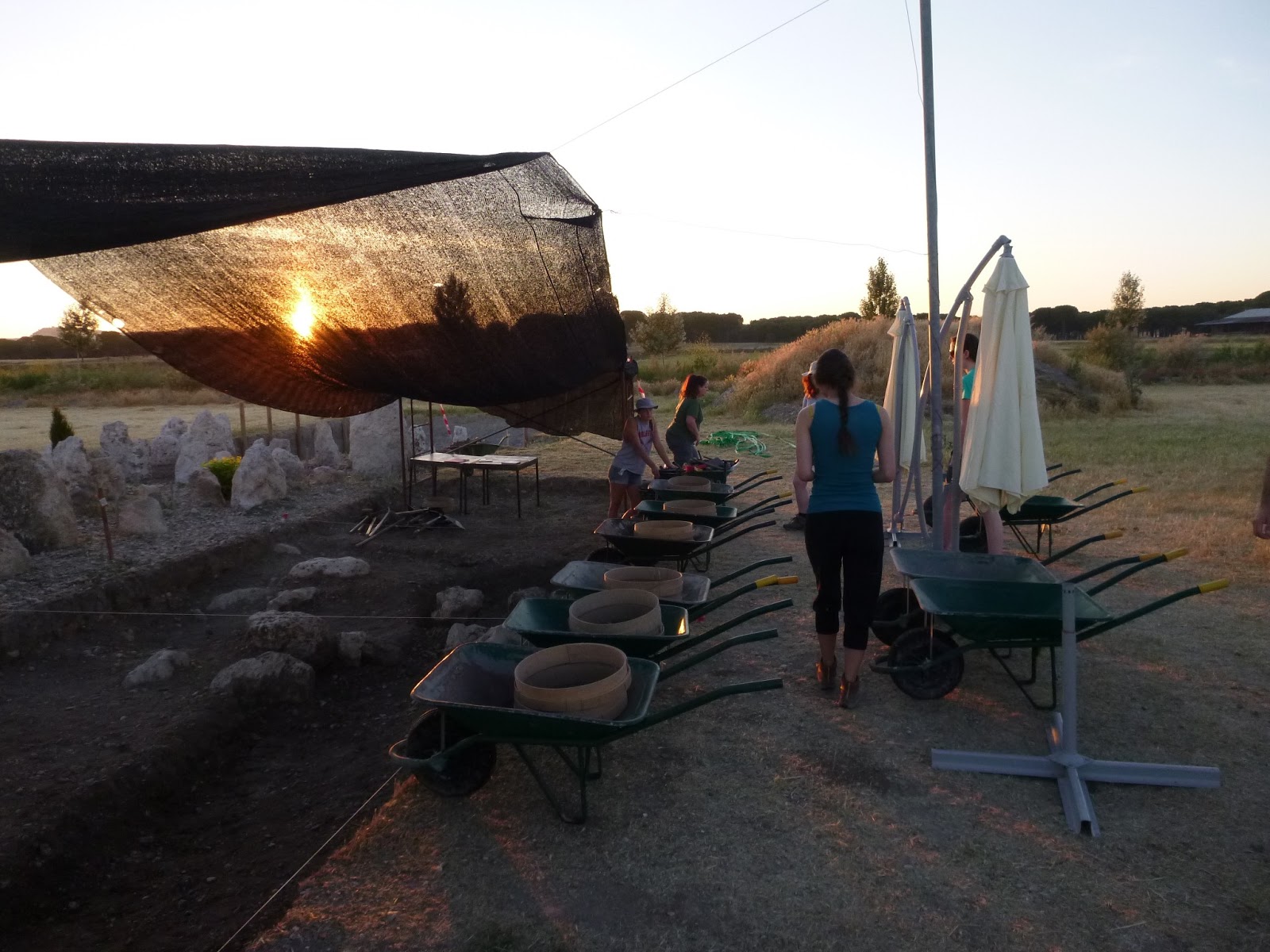
The dig site on the first, hard, hot day at work.  It is a bee-hive of activity,
with people using pick and shovel to remove the soil, screeners sifting the dirt
for artifacts, and people moving wheelbarrows full of dirt to the ever-growing mound
in the background, as well as loads of large stones and gravel.
All this is a rather abbreviated introduction to what your Intrepid Traveler is doing grubbing around in the dirt of north-central Spain.

We dig from Wednesday until Sunday, with Monday off for rest and recuperation (much needed, believe you me!) and Tuesday for excursions.  There are also lecture-seminars and workshops here and there.  We typically arrive at the site at about 7:00 am – I love watching the early-morning sun rise over the hills in the east as we walk to the site.  We work until about 1:00 (with a break for snack), by which time it is getting quite hot, and close up shop for the afternoon.  Lunch is at about 2:30, followed by that lovely, eminently civilized institution known as the la siesta.  You can nap or not; I usually opt for nap rather than not.  By 5:30 we are back at the site for 2-3 hours of work in the evening.  Dinner is at about 9:30, after which most of us are to be found around the corner at Padilla’s only pub talking and laughing and socializing with the locals.  Bedtime is…well, rather late some nights shall we say.  I feel as if I am operating on a constant sleep deficit, but that is also partly due to the arduous nature of the work.
Start of the day at the site our second day (note awning and umbrellas).
In the eastern quadrant you can see the beginnings of the large stone
stelae we uncovered.  By now these are all completely exposed and
will be removed on our next day at the site.
The first day just about did most of us volunteers in.  We started on a Saturday at the peak of a heat wave.  They had not yet set up the awning or brought out the café umbrellas, so we worked in the blazing sun for the two shifts.  And it was hard work – not the neat, trowel and brush work one associates with archaeology, but tough pick-and-shovel digging to get down to the level of the tombs some four feet deep.  Over the next few workdays we moved tremendous amounts of earth and rock (lots of rock!) in buckets and wheelbarrows to a growing hill of debris.  Each bucket had first to be screened for artifacts, for even though the tomb level is pretty deep, after the first few inches of dirt, one starts to find shards of pottery and, as one delves deeper, fragments of bone (both animal and human) and some iron and bronze objects.  All the time we were being given directions in Spanish (translated by ‘Lovely Rita,’ the wonderful young Portuguese translator and archaeological staffer), as well as in mixed Spanglish and a lot of hand gestures. (More on the staff here at Pintia later…).  At any rate, given the heat, the hard work, and the inevitable confusion due to language and unfamiliarity to the work for most of us, by the end of the first day we were a sweat-drenched, bone-tired, and mentally exhausted bunch by the end of that first day at work.  I am sure many of us – myself included – wondered just what the hell we had gotten into.
Heading back to Padillo de Duero after a long day 'in the trenches.'
Still, Sunday and subsequent days were much better as the temperature moderated somewhat (from over 100° F to the upper 90°s and gradually downwards).  Plus, blissfully, the first thing we did evening shift on the first day, was to set up an awning over site and bring in some café umbrellas to shield those screening the dirt from the unrelenting sun.  That definitely perked us up!  Also, as we got deeper and deeper, and found more and more and varied artifacts and bones, we began to sense the presence of tombs beneath us.  One dead give-away was the emergence of a number of large limestone stelae that were typically used as grave markers by the Vacceans.[3]  These are concentrated in the eastern quadrant of our double excavation (each unit is 4 x 4 meters – so we are excavating an 8 x 4 meter pit), so digging that section is pretty interesting as well as extra challenging and quite a bit slower going. 

Just two pieces of pottery I happened upon at the dig in the first days.
At left, the bottom of a ceramic jar; at right, a lovely, handmade and
decorated part of a child's rattle.
As I write this, it is the second Monday of the dig, and I have been enjoying the first morning of quiet to write before everyone wakes up for a day of leisure – involving a trip to Peñafiel for personal supplies, and perhaps some local touring.  We have worked feverishly the past few days under a deadline to get the site ready for the removal of the largest stelae on Wednesday when we return to the site.  That will be a pivotal moment, a sort of starting gun for the real fun work of finding and excavating the tombs below.  About which, as I am wont to say, more later….


______________________________________________________________________
In descending order of prominence, here are the major cities and towns in the area:

Valladolid (elev. 2,290’, founded 1072, current population 311,501) is the closest city; it is 190km/118mi NNW of Madrid . Originally settled by the Celtic Vaccae (same as we're digging up), then inhabited under Roman occupation until it was officially re-established when King Alfonso VI of Castile gave it to some bloke he owed a favor to (Count Pedro Ansúrez). The town lies at the juncture of three wine regions. Also, Cervantes lived here for three years while finishing up Don Quijote de la Mancha in 1606. Currently, it is a university town and a center of the auto industry. 

Peñafiel, 55km/34mi due east of Valladolid, is the nearest medium town (elev. 2766’, pop. 5,500). It known for its Reconquista-era castle, and its medieval town square, the Plaza Del Coso, which is used for bullfights. Also, during the Middle Ages it had as many as 19 churches. 

Padilla de Duero (elev. 2,477’) is a tiny hamlet of 68 souls 4km/2.5mi west of Peñafiel. The dig site is a few hundred meters north-west of the village. There is no castle, or anything else (1 church only), for that matter, of fame or import. Just a few local bodegas (wine cellars) and one very convivial pub.

Pintia, the site of a Celtic city-state (Las Quintanas) and necropolis (Las Ruedas), is the name the Romans gave the site when they got around to naming stuff. Population some tens of thousands of 2,000-year-old dead Vacceans.


[1] Governmental power in Spain has, for centuries, vacillated between centralization in Madrid, and a more decentralized (quasi-Federal, in US terminology) impetus.  This dialectic has been especially pronounced in the last 150 years or so.  Currently, after four decades of extreme centralization under Franco ended in the mid-1970s, decentralization prevails. 
[2] To this day there is a continuity of belief regarding the vulture.  It is the custom here to leave dead livestock in the open to feed the vultures.  Unfortunately, the government has decided that this is ‘unhygienic,’ and is trying to put a stop to it.  Besides disrupting long-held custom, this has had the effect of turning carrion-eating vultures into birds of prey – for lack of already dead food, they have begun killing young livestock.  Apparently our government in the US has no monopoly on idiocy.
[3] They have confirmed that at least some of these large stone monoliths were quarried some four miles away; there is no limestone in the immediate vicinity of the necropolis.  This must have been quiet a production, dragging these huge rocks across the valley; the Vacceans clearly took death and the afterlife very seriously.

Wednesday, July 10, 2013

Madrid

My Fearless Readers will be relieved to be informed that, were Generalissimo Francisco Franco able to walk the streets of Madrid as I have recently he would certainly be most disturbed by what he saw. 

He would see gay couples strolling down the street holding hands with nary a side-glance
cast their way.  He could hardly miss the common sight of brown- and black-skinned people hailing from such far-flung locales as North Africa (mostly Morocco, a former colony), the Philippines (another former colony) and elsewhere in Asia, and, of course Latin Americans galore.  All of this diverse humanity, and all speaking Castilian like natives (oh, wait, many of these people are natives!) and doing their business like they belong – this would be pretty horrifying for the old fascist.  Franco would certainly frown on the gangs of young skateboarders whooshing down the streets and using the public parks to practice their moves.  I also think he would look askance at the way the police in Madrid handle vagrants and Gypsies.  I saw two burly motorcycle cops in a posh neighborhood interviewing one homeless man with what I can only describe as solicitude; the man was obviously stone drunk at 11:00 am, dressed in a rumpled jacket with tie askew, and they were gently asking him how long he had been on the streets, where he had lived before, did he have family….  Cops as social workers?  The Generalissimo would have booted those cops off the force, or worse.  As far as the Roma are concerned, if they made a nuisance of themselves I saw cops essentially herding them away without a hint of brutality or even disdain; elsewhere in Europe, both east and west, I have witnessed and heard of true sadism in the way officialdom treats the Gypsies.

This is what I witnessed in my two days in Madrid before proceeding on to my dig (on which much more later…).  What were my other impressions of the grand city, you may well ask? 

I re-immersed myself in the café culture with a sigh of contentment as one entering a pool of cool water on a sweltering day; for me it was like a homecoming.  This is one thing that Europeans do so well I don’t think any American could possibly argue otherwise.  (Any challengers?  Meet me in Madrid beginning of August and I will cheerfully prove you wrong.)  To my mind, there is nothing so civilized and sensible as to sit down at one of the hundreds of sidewalk cafés proliferating in Madrid’s streets and plazas, order a coffee/beer/sandwich/pastry, and sit unmolested for an hour sipping, reading, watching humanity pass by (many likely headed for their own favorite café).  The only downside is that you are sometimes so thoroughly left in peace that it is hard to get the waiters to notice you long enough to bring another tonic or the bill.  I like to sit and try to puzzle out who my fellow patrons are.  Why is the guy at the next table so formally dressed on such a nice summer day?  The old lady seated next to the waiters’ station clearly
is a regular; they fuss over her and bring her drinks and pastries without her having to order.  The young man three tables over – he keeps glancing down the street – is he waiting for a date or lover?

Another aspect of life in Madrid – and much of the rest of Spain, as I understand – are the twin institutions of the mid-afternoon siesta and the late evening paseo.  Like the ubiquitous cafés, the siesta and paseo are, to my mind, eminently civilized.  Siesta I am sure you are all familiar with.  One eats a light breakfast here of pastry, toast, coffee, whatnot; then to work until about 1:30.  Lunch is the big meal, usually eaten around 2:00 or so, followed by an afternoon of rest – including a nap as prescribed.  Being largely civilized, I usually prescribe myself a nap.  Back to work around 5:00 until about 8:00 in the evening when everyone goes home for dinner or finds a good tapas place or a restaurant.  Both evenings I spent in Madrid I opted for tapas at places with outside seating in the Plaza Santa Ana, near my hotel.  There are a half-dozen such places around this square, and if you stroll by anytime before 8:30 they are empty.  Around that time, however, the better places begin to fill up rapidly with folk coming off of a day’s work to meet friends for wine, beer or whatnot, and rounds of tapas.  Most people I observed spent less than an hour, and then moved on – presumably to another tapas spot,
My first night I happened to order a dish of Spain's premier
 Jamón Ibirica.  Better than most Italian prosciutto I have had.
perhaps even stopping at three or more in the evening.  (Tapas I also rate high on the civilized scale). 

As folks finish up their round(s) of tapas or dinner out or at home, then comes the paseo.  The plaza my hotel was off of, the Puerto del Sol, was fairly empty during the day, save for Madrilleños passing through or shopping nearby and, of course, las touristas wandering about snapping photos.  This changes dramatically starting around 10:00.  At this point, for a couple of hours, the plaza is teeming with humanity of all sorts.  Some simply stroll about, meeting up with friends or taking advantage of the prime people-watching opportunity.  Young folk meet up to chat, or to go on to the bars.  Mothers take their babies out in their strollers and toddlers run about gaily.  There are street entertainers galore – both nights a group of young men had an act where they got young women to volunteer and taught them a hip-hop dance, to the cheers of the crowd of spectators.  Chicago has buskers on the streets and in the subways, mostly licensed, and many quite good at their guitar or violin.  In Madrid, it’s like one big  concert – I heard a saxophonist one afternoon riffing for some time on what sounded like, but almost certainly couldn’t have been, When the Saints Come Marching In.  And, just outside my hotel off the plaza one night at about 11:00 I stopped to listen to some of the most beautiful operatic music I’ve ever heard.  There were three young men playing arias on violin and a man and a woman singing O Sole Mio and other familiar duets.  They were so good that the ‘donation’ violin case was full both of Euro coins and bills (to which I happily contributed a fiver).
The paseo one night in the Puerta del Sol.  The best people-watching
I have ever experienced!
I did a lot of walking during the mornings before it got too hot, and in the evenings.  Madrid is a wonderful walking town.  Much of the old, historic district is strictly pedestrian, and they even hang a sort of awning system between the buildings in order to provide shade for people strolling underneath.  People walk in the parks, especially the grand Parque del Buen Retiro.  This was originally the grounds for a royal palace, but in the 1770’s King Carlos III opened it up to ordinary Madrilleños.  This particular Carlos did much to beautify the city with fountains and new plazas.  He clearly loved Madrid, and Madrid loved him back; he earned the nickname of “Best Mayor of Madrid,” and he is permanently memorialized in bronze, astride a horse in the middle of the Puerto del Sol.  

Statues.  Like other European countries I have visited, Madrid abounds with the usual statues dedicated to this or that politician or king or queen or general.  But, also like other European countries, there are just as many statues dedicated to writers and poets and painters – Lorca, Goya, Cervantes, and more that I sadly did not recognize. 

The Spanish clearly love their literature and all forms of writing.  In the States, the small bookstore is disappearing, and even some of the big bookstore chains are shutting down.  It is actually difficult for me to find a store with actual books of actual ink and paper and thread and glue near my house, aside from my favorite used book store.  In Madrid it seems every street has its little bookstore and an Antiquarium or two.  There are, with no exaggeration, hundreds of bookstores in the city.  As I emerged from the Parque del Buen Retiro on the 4th, I found myself on booksellers’ row – one side of the street was all booths selling books new and used and antique. 


I also saw on that street an inspiring tribute to our national holiday.  A lovely young
Madrilleña rollerblading gracefully up the way wearing an abbreviated American flag t-shirt.  I saluted her on numerous accounts.  I also saw an apartment building on a narrow street with a string of little American flags hanging from the balcony – most likely expats – and a few bars sporting old glory, inviting Americans in for a party.  I think the Spanish might be one of the last Western European countries which still like us. 
Then again, the people of Madrid and of Spain in general, in my short experience, are among the friendliest folks I’ve encountered.  They greet total strangers with a cheerful hóla! and a smile.  As I travel beyond the capital and encounter more Spaniards, I find their humor to be earthy and contagious and their hospitality beyond compare; I have had to be very firm and a little crafty in order to buy a round of drinks, for instance, since they insist that they are my hosts.

Goya: The Second of May.  Spanish protesters in 1808
ridden down and massacred by French troops, including
North African colonials.  (This event took place across
the Puerto del Sol from my hotel).
The other thing I made sure to fit in my schedule was a visit to Spain’s premier museum – indeed, one of Europe’s finest – the Prado.  I discovered that from 6-8 on some weekdays entrance is free.  So did about 500 other tourists from all over, as well as locals.  So I made two visits on succeeding evenings and spent some quality time with Titian, Raphael, … and especially with El Greco and Goya, two painters who have long held a special fascination for me.  I discovered new paintings (especially from Goya’s ‘black period’) and for the first time gazed on long
Goya: The Third of May.  This event took place on the
grounds of the Royal Palace in Madrid.
familiar works.  In particular I came to a new appreciation of Goya’s two paintings – the 2nd of May, and the 3rd of May, both commemorating the inauguration of Spain’s long, ultimately victorious guerrilla against Napoleon’s attempt to swallow the country whole (the Spanish invented the guerrilla war in the modern sense of the term, harrying superior French forces until they were paranoid, exhausted and demoralized and, finally, gave it up for lost).  I learned elsewhere that the events of the 2nd of May took place a stone’s throw from my hotel, at the district administration building at Puerto del Sol.  A crowd of Madrilleños had gathered there to try to prevent the French from absconding with the royal family and were brutally attacked; the next day there was a mass execution on the grounds of the royal palace.  Goya went on to do a series of drawings called the Los Desastres de la Guerra which to me remain one of the most modern and moving anti-war statement in history. 
Disastres de la Guerra.  Some of the most disturbing and modern anti-war art
ever produced.  Depicts the prolonged, bitter and bloddy Guerilla war the Spanish
conducted against occupying French forces.  The French, with some help from
England's Duke of Wellington and his army, eventually quit and went back home.

I shall finish with one last observation on Spanish cuisine – the first of likely many to come.  Every culture, it seems, has its own national comfort food to which natives come back to time and again.  In the case of Spain, it is ham.  Not ham as we know it in the states, but something closer to prosciutto – and they have dozens of varieties.  Without intending to, the first tapas dish I ordered ended up being the primest of the prime varieties of jamón – and it was dreamy.  Then I started noticing that the deli’s in Madrid were not just places to buy ham and such, they were advertised as El Museo del Jamón.  How can you not love a people who regard their nation’s best food as worthy of museum treatment?

You gotta love a people who elevate their favorite delicatessen food to museum status... 


Friday, June 21, 2013

Crusader Poop

My brother the archivist sent me this link the other day:


Ancient Toilet Reveals Parasites in Crusader Poop

Besides the fact that 'Crusader Poop' was the name of my first band, it was most welcome.  As my veteran Fearless Readers will be aware, I have become something of an Archaeology groupie, having spent part of the last two summers digging up old stuff out of the red Virginia Piedmont clay.  So it was fascinating to read about what they've learned about 12th century crusaders.  To the uninitiated, Scatology (also known as Coprology), is the study of ancient (sometimes verrrry ancient, as in dinosaur ancient) feces to learn about diet, disease and the like.  I have yet to see this arcane science at work; however, wouldn't that be a great way to introduce yourself at cocktail parties?  Can you imagine how many chicks (or dudes) would go for the line "Hi beautiful, I'm a Coprologist.  Wanna come home with me and look at my shit?"
A crusader 'necessary' in a castle on Cyprus.  Archaeologists love nothing more than a good latrine.
Maybe I'll get to study some Celtic crap at the dig I'm going to in Spain in a couple weeks!


Thursday, June 20, 2013

Delayed Gratification

N.B. This essay is dedicated to Renée Hoskin-Schiber.*

Fearless Readers, after a long and painful slog, another academic year draws to a close for Chicago Public Schools and for your intrepid urban educator.  Of course, the rest of the country has been out of school for going on two or more weeks by now, but ole Mayor Grinch** wants us, students and teachers alike, to carry on beavering away at making quality education a reality for the youth of the Second City.  And so we remain, awaiting the end of a particularly soul-sucking 2012-13 academic year at my school.

But, what I really want to talk about now is what keeps us teachers going nowadays.   The public school system in this country has been under attack, in the dubious name of ‘reform’, for quite some time.  In Chicago it’s more like being under siege.  And, of course, it’s the teachers – the infantry grunts – who bear the brunt. Meanwhile, about all the politicos and pundits and just plain pests can agree on is that it’s all the teachers’ fault.  It’s those reform-resistant, union toadies who are failing our students. (It’s gotten so ubiquitous, this teacher-bashing, that it deserves a name:  Historian that I am, I propose theTeacher Scare.  Sort of like the Red Scares of the 19-teens and 1950s.  As in, “Are you now, or have you ever been, a Public School Teacher?”  But I digress.)  Point is, why do we stick to the job in the face of all the ill use at the hands of everyone from the President on down to my own principal?      

Talking to colleagues throughout the years as well as myself (yes, I do talk to myself – something wrong with that?), I have a pretty good idea of why teachers teach.  In Chicago, thankfully, public school teachers earn a decent, if not extravagant living wage, unlike lots of places in this county, not to mention pretty much the entire Southern Hemisphere.    But nobody in their right mind goes into teaching for the money – it’s simply not enough to compensate for the turd balls thrown at us every day, mostly from our own admin.  No, we teachers teach because we love to teach.  Yes, we do get a few really cool side benefits with the job, chief among which is summer break, that one glorious perk almost all teachers enjoy.  But mainly we are among those who follow a calling, rather than a career.  And the Calling has its own perks.  For instance, we on occasion get to enjoy that particular shot of pure joy that most teachers experience when a student’s eyes suddenly light up with enlightenment and understanding.  Those and other similar moments with our students are like fuel for teachers; they keep us going for days afterwards.  But the real reason we follow the Calling, and our primary source of fulfillment, boils down to one thing.  The Future.

Right, cliché of all clichés.  Our children, our future, blah blah blah.  So let’s make it more real and less Hallmark.  OUR children.  By which I mean MY children.  By which I mean the students who I spend my days with in the classroom every week.  Most days I could give a rat’s ass if AMERICA is falling behind the Chinese in Math, or that Finnish kids can ace a basic US Geography quiz that most adults here wouldn’t even pass.  My focus?  Will Jorge get his 4th grade reading level up enough in his four years at my high school to be able to survive when he leaves?  Will bright, young Amanda manage to avoid getting knocked up by some boy (emphasis on ‘boy’) before she escapes the hood and gets safely away to college?  It’s hard to get too exercised about the potential impact our latest educational crisis might have on future US global competitiveness when so much is stacked against my students.  How relevant is keeping ahead of Japan when dodging rival street gangs on the way to school is their daily reality?  

So we teachers, urban or rural or suburban, are the world’s champions at delayed gratification.  Particularly in a public climate that lately has been so poisonous against us, we have to wait quite a while in order to reap the rewards of our calling.      Anyway, back to reaping rewards.  Once in a while, randomly at the grocery store, or at report card pick-up or some other school function, a former student will seek you out and, in the course of catching up and such, let drop that you, their 10th grade US History (or Art, or Math) teacher, somehow, in some small way, ever so slightly changed their lives for the better.  It rarely has to do with actual academics.  It’s more like, “Mr. Peabody, I was such a shit in your classroom as a sophomore, but that didn’t stop you from treating me fairly.  I learned something from that.”  Or, “Ms. Ashley, I can’t hardly remember a damned thing about Calculus, but the way you always tried to explain things in interesting ways that we could all understand taught me something.” 

These seemingly small moments are our life support system as teachers. I walk away feeling a warm glow that lingers for weeks.  One such encounter gives me the energy and motivation to soldier on, knowing that the work I do has – or will have – a lasting and meaningful impact on the lives of at least some of my charges. 

Last weekend, I was fortunate enough to meet with over a dozen former students and find out how they are doing.  I held a small reunion party at my house for students who had been on my debate team back when I was coach.  One of my debaters, just about to graduate college, had texted me out of the blue a few months ago, which led to a meal with three of my former charges, all of whom wanted to let me know how they were doing and how important they saw my own influence in their success (which was good for a couple of months renewed inspiration!).  This, in turn, led to a larger gathering at my place on a lovely Sunday afternoon, complete with burgers, dogs, brats, and fixins.  And 16 young folk with whom I had spent countless invigorating hours over my years as a coach.  These bright young people had spent time with me in twice-weekly afterschool practices, at pre-tournament Saturday practices, at winter and spring break practices at my house, during Saturday debate workshops, and, of course, competing in a half dozen or more marathon weekend debate tournaments per year.  Of necessity, we all became quite a close-knit band, all watching each others backs, and sharing in triumphs and trials alike.  The fact that they were eager to spend another few hours together and with their old coach, years after graduation, was deeply gratifying for me, but not surprising.  These were, after-all, MY kids.


I always maintained that the job of debate coach, although arduous and mostly unpaid, allowed me the privilege of hanging out with the funnest kids in the school.  This past Sunday proved the truth of that even after they have long since graduated.
Even more gratifying was to learn through the course of the afternoon that all of my kids are doing well. Most are either still at university or have graduated and started on a career.  One of my girls just had a brand new graduate assistantship position created just for her – involving the teaching of public speaking.  Another graduated a year ago and has embarked on a career in advertising.  A third has just graduated from an elite West Coast private college where she spent considerable time studying abroad in Asia as part of her degree program.  Yet another has girl more year left at UIC, where she has been involved in a myriad of organizations and causes.  Others, who have not followed the collegiate path (yet – I still hold out hope!) are pursuing training as chefs, are retail sales managers, are working as trainers for restaurant personnel.  One of my team captains stumbled accidentally into a career as a personal banker when a bank manager noticed her and was impressed by her intelligence and comportment.  She’ll soon be making more than I do!  College or not, all of my young folk are embarked on building what promise to be fruitful lives.

As my crew was wrapping up the party – some three happy hours after I had anticipated it winding down – I told them how proud they had made me, all grown up and productive and responsible young men and women.  When I was debate coach, I was famous for my impromptu, often teary end-of-season inspirational speeches delivered on that last, late-night bus ride home from the City Championship tournament.  This was no exception; indeed, I would have disappointed if I hadn’t delivered my requisite pep talk.  On this occasion, however, they interrupted my speech, because they had their own message for me.  They told me that, like it or not, I was in large part responsible for their various successes. 

For once I did not mind being interrupted by my students.

So, in a nation rampant self-entitlement and instant gratification, we teachers bide our time, patiently, for the seeds we sow to sprout, take root, and flourish.  Our reward, when it comes, tastes all the sweeter for the wait.  
___________________

* Renée is a 25-year veteran teacher from downstate Illinois.  In her 13 years of service at Collinsville High School, a school she describes as 'working class' and 'hardscrabble,' her AP English students scored 20% above the national average.  She also wrote a grant to add technology -- such as a Smart Board -- to her classroom.  She is that sort of teacher.  Renée  ran into trouble with her administration when she failed to get the message to change the grade for the Assistant Superintendant's daughter; the following year it was the child of a School Board member.  Finally at the end of this year she was forced into retirement to as punishment for her professionalism and integrity.  

** I have decided that Mayor 'He-Who-Shall-Not-Be-Named' is rather unwieldily, and the acronym HWSNBN is simply impenetrable.  Plus, well, just look at the original Dr Seuss cartoon and compare that to a picture of the mayor of Chicago.